


RAVN ERICKSEN Denmark / Sweden TOP 3 Prize

Whose Dysphoria
Self portrait on medium format film.
Ravn Eriksen 23, is a photo-based artist from Copenhagen, studying fine art photography at HDK-Valand. They use the camera as a tool to explore how external expectations affect self-perception and the perspective on one’s own identity. Ravn’s work is rooted in relational contexts, focusing on family dynamics and the significance of close, chosen relationships. In their practice, they focus on creating a visual dialogue between their personal experiences and a broader narrative.
CHASE LECH USA TOP 3 PRIZE

Lost Within Myself
This part of the journey is the beginning, the moment when you find yourselves at your lowest, most uncertain point. It is a space where identity slips through our fingers, and the reflection in the mirror feels like a stranger. You cannot recognize yourselves. All that’s left is a silhouette, a hollow shell of who you once were or hoped to be.
Chase Lech 21, is a photographer and visual storyteller who grew up in Connecticut and is based in Washington, D.C. Their work encompasses a range of photographic styles, from studio to fine art to street. What drove him to try so many styles and take so many pictures is that he finds joy in taking photos; he loves that you can capture a moment and tell a whole story with it. His passion for photography was discovered by chance in high school when, as a sophomore, he enrolled in a random photography class. However, taking that single class led him to a passion that would last a lifetime. Chase continues to take photos as much as he can, trying new ideas and techniques to challenge himself and grow.
NATALIA ZAORSKA Poland TOP 3 PRIZE

Guillotine No.1
Self-portrait created in my workplace, where I take ID photos on a daily basis.
The idea arose from observing the ritual of mechanically cutting off heads — a repetitive gesture performed hundreds of times, in which the human being becomes part of the procedure, absorbed into the rhythm of production. The guillotine, a tool of precision, turns into a metaphor for labour subordinated to machinery, bureaucracy, and systemic demands. In the act of cutting myself out of my own image, a double exploitation is revealed: that of the worker’s body and identity.
The face — the essential mark of individuality — is erased, covered, reduced to a product. The job, seemingly about producing images, in reality leads to their elimination. The work also comments on commodity fetishism: the image becomes a product that must conform to an official standard, while the worker becomes an instrument of its production.
The self-portrait made in the workplace exposes the absurdity of this situation — while producing the images of others, the artist loses the ability to create her own. Guillotine No. 1 is also a reflection on the struggles of young people navigating the labor market — on the sense of replaceability, on precarious work that rarely offers subjectivity or stability. It is a self-portrait of a generation for whom work becomes an act of survival rather than self-realization.
Natalia Zaorska 24, is a Masters student at the Faculty of Media Art, Photography, and Experimental Film at the Academy of Art in Szczecin. In her practice, she deals with photographic images and sculpture exploring the themes of conceptual and performative photography and ancient means of obtaining photographs. The main themes in her works are death, penitence, queerness, and materiality (both in photography and sculpture).
KEITARO MORI Japan

Healthy and Sad
This photograph is a reconstruction from my series [Health2]. I question how concepts such as health and happiness have become social norms that one must obey to be accepted. The helmet covered with flowers functions both as protection and as decoration — a symbol of the struggle to appear gentle while being suffocated inside. It represents the paradox of being safe yet uncomfortable, beautiful yet wounded. Through this self-portrait, I attempt to reveal the quiet tension of living under invisible pressure, and to show how vulnerability can still be a form of resistance.
Keitaro Mori 20, is enrolled at the Department of Photography, Nihon University College of Art.
His work visualises the aspects of contemporary society that obstruct the pursuit of individual happiness by leaving no room for questions or doubts. This is achieved through a poetic and realistic reconfiguration of imagery.
CIARAN INNS United Kingdom

Is He Family?
Is He Family? is a collaborative body of work created with Neil, my former drama teacher and now friend. The project takes its title from the coded language once used within queer communities, where phrases such as “are they family?” offered recognition, safety and solidarity at a time when being openly gay meant risk. That quiet code of belonging sits at the heart of the work: a conversation across generations about queerness, kinship, and what it means to belong.
In making these images, I sought to move beyond the erotic lens through which queer male identity has often been framed. With his history and presence, Neil becomes a bridge between different eras of queer life. Photographing him is both an act of care and recognition - a way of seeing identity not through desire, but through empathy and shared experience. The theatre, where much of the work is staged, becomes a natural setting for this dialogue: a space of performance and transformation, but also of memory and rehearsal, where identities are discovered, understood and preserved. Alongside these portraits, I photographed objects from Neil’s home - markers of shared history and conversation. Together, they form a reflection on chosen family and the ways intimacy, collaboration and creative play allow us to connect and belong, regardless of who we are.
Ciaran Inns's 24, talent for image making has developed over many years, beginning with an interest in stop-motion animation which led him to study photography at London South Bank University. In 2025, he will complete an MA in Commercial Photography at the London College of Communication (UAL), where he continues to develop his approach to visual storytelling.
KEXIN LIANG China / United Kingdom

Disposable Rooms
In the contemporary urban landscape, the condition of constant relocation has become the norm: renting, moving again, settling temporarily, then moving on. Home becomes not a fixed point but a series of provisional states.
My photography series ‘Disposable Room’ reveals how ‘urban nomads’ rely on cheap, standardised soft furnishing commodities to pack the temporary rented unfamiliar space as ‘home’ in the process of frequent moving. With the accumulation of these objects, identity seems to be temporarily sewn together, but in fact it is a kind of self-deception - the commodities fill in the identity gap, but at the same time define the person in turn. This ‘False Sense of Presence’ is not a true sense of belonging, but a colonisation of the individual by consumerism.
This project deconstructs the power relations between ‘objects’ and ‘identities’, and undermines the ‘sense of belonging’ that is manipulated by commodification. When ‘identity’ is reduced to a prefabricated commodity on the shelf, can we still maintain our subjectivity? The work questions how our generation struggles to construct a collective syndrome of self-identity in a cycle of migration and uncertainty, where identities seem to be replaceable at any time.
Kexin Liang 25 is a multi-disciplinary visual artist hailing from Qinhuangdao, a quaint Chinese seaside town. Currently, she is advancing her studies in Commercial Photography at the London College of Communication.
JORGE CARRILLO Mexico

Metamorfosis Digital
This self-portrait emerges from the depths of a crucial moment in the university social movement. Captured amidst the euphoria and tension of the protest, it unfolds as a visual testament to my own immersion in the struggle. Here, the hooded figure transcends anonymity; it becomes a vital symbol of resistance and, paradoxically, of identity. In a country marked by the harrowing history of enforced disappearances, where visibility can be a death sentence, the hood is not a denial of the self, but an affirmation of collectivity and a survival strategy. It is the protective layer that allows for a voice, the veil that safeguards integrity against constant threat.
Jorge Carrillo, 25 began his journey as self-taught, it was art school that gave him the tools to transform intuition into artistic intent. There he overcame the block of "not knowing what to photograph", maturing his fascination with the glitch until it became his signature. Validation came at his first school exhibition, when a spectator wanted to buy one of his pieces; that moment confirmed that this "explosion of emotions" had to be shared.
ADINA SALOME HARNISCHFEGER Germany

Self-portrait on the side of the road in Portugal
Adina Salome Harnischfeger, 25 is a photographer based in Dortmund, Germany. She is currently studying photography at the University of Applied Sciences and Arts, Dortmund. Her work explores themes of intimacy, relational ties, embodiment, and societal expectations—often through a personal and feminist lens.
Her photographic language moves between documentary observation and staged imagery, aiming to make emotional states, memories, and social roles both visible and tangible. Self-portraiture plays a central role in her practice, allowing for a direct and vulnerable dialogue with the viewer.
By interweaving multiple layers of meaning and form, her work cultivates a sense of ambiguity that invites viewers into a space of introspection and personal reflection.
JINGYAO JIA China / United Kingdom

‘Entanglement’
Entanglement is an auto-portrait created through a six-minute meditation at the site of a past trauma. It visualizes the persistent fatigue of living with bipolar disorder, set against a culture of academic pressure and enforced silence. This image is not about healing, but an act of reclamation. The long exposure etches a body in resistance, a deliberate contrast to the demand for relentless output. It frames survival as a continuous negotiation with the shadows of memory and the weight of a stifling environment. I am a spiral, entangled in the vines sinking into the big tree. The big tree wraps me up, and I wind around its growth rings. (originally written in Chinese: 我是一颗螺旋/ 沉在大树里的藤蔓/ 大树将我包裹/ 我向年轮缠绕)
Jingyao Jia, 22 is a photographer working between China and the UK. His long-term project, China’s Occident, England’s Orient, explores simulated landscapes and architectural replicas in both countries, examining how cultural symbols become detached from their origins and reinterpreted. He recently graduated with a first-class honours degree in BA Photojournalism and Documentary Photography from the University of the Arts London.
ANGEL RIVAS Peru

Aplastado
“Despite being trapped beneath this rubble, on the brink of death: I feel its weight, I feel its coldness, I feel the dirt on my skin, the bruises on my body register each of these sensations in search of an answer as to why I am dying again.”
'"Part of a photographic series I did about death in my dreams. I combine performance and recording as a method of confrontation to find a reason why I have these dreams and to discard ideas that threaten my life. I add the value of simulation to the image; it is a dream that has not materialised in reality. Because I am still alive, that is why I consider it a simulation based on what I see and what does not happen. Even after finding the reason why I have these dreams, another question would arise: would I still be me, or would a new me be born from death?"
Angel Rivas 21, is a Peruvian photography student looking for new media to express his photos. He started photography five years ago, and is interested in continuing to gather his own experiences and those of others,
GUILLERMO MORA Peru
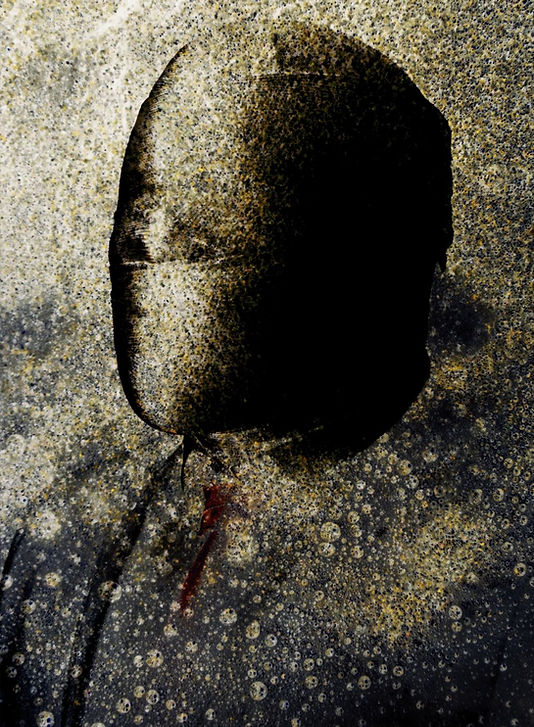
ID
The ID project represents my tireless quest to understand who I am. The photographs seek to explore the thoughts and feelings I experience during my search for my identity. This photograph is a double exposure of sand and sea, directly related to the end of the poem "El lenguado" by Peruvian poet José Watanabe. It is an acceptance of the idea that identity is not unique and is something that expands.
Guillermo Mora, 20 is a photographer and visual artist focused on exploring identity and everyday life through images. His work combines documentary narrative with an aesthetic quest that dialogues between the intimate and the collective.